The Marsten House’s reoccupation
'Salem's Lot: A NovelThe Marsten House’s reoccupation is the decisive return of an old evil to Jerusalem’s Lot. After decades in which the house remained associated with Hubert Marsten and Birdie Marsten’s violence, Richard Straker moves into it with his business partner, Kurt Barlow, while their antique shop opens in the former Village Washtub. The change is presented publicly as commerce and privately as recurrence: the house is occupied again, the town is watching, and a child soon disappears.
A Notorious House Re-enters Public Life
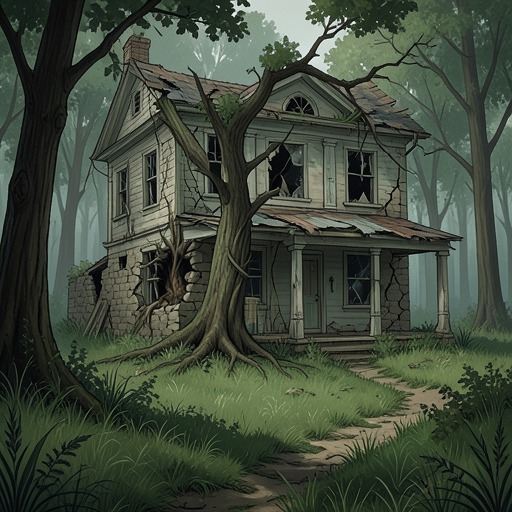
The house is not an ordinary property when Straker and Barlow take possession of it. Its previous occupants, Hubert Marsten and Birdie Marsten, had left behind the town’s most enduring domestic scandal, a story preserved through generations even though the violence occurred before most living residents were born. The Marsten House therefore functions as a physical container for communal memory. Its history is not merely archived in newspapers or family talk; it remains attached to the building itself, so that occupation becomes a form of reopening the past.
The town’s historical character makes that return especially ominous. Jerusalem’s Lot had been incorporated in 1765 and celebrated its bicentennial with fireworks and a pageant, yet its local memory remained more durable than its civic ceremonies. The town’s roads, river, farms, trailer district, and old wooded high ground form a compact social world in which private behavior quickly becomes public knowledge. The Marsten House stands on the last of the wooded hills in the northwest section, spatially elevated and separated from ordinary town life. Its isolation gives the reoccupation a double meaning: Straker and Barlow enter the community as businessmen, but they establish themselves at the precise edge where the town’s past has never become fully ordinary.
Straker, Barlow, and the Antique Shop
The reoccupation becomes visible when Straker opens the shop in the old Village Washtub. The former laundry has been transformed by an interior decorator’s truck from Portland. A raised platform covered in light-green, deeply textured carpet fills the display window, while concealed spotlights illuminate a clock, a spinning wheel, and an old cherrywood cabinet. Each item receives its own small easel and discreet price tag, including the startling price of six hundred dollars for the spinning wheel. The arrangement gives the shop an air of cultivated taste and deliberate theatricality, sharply contrasting with the building’s former utilitarian life.
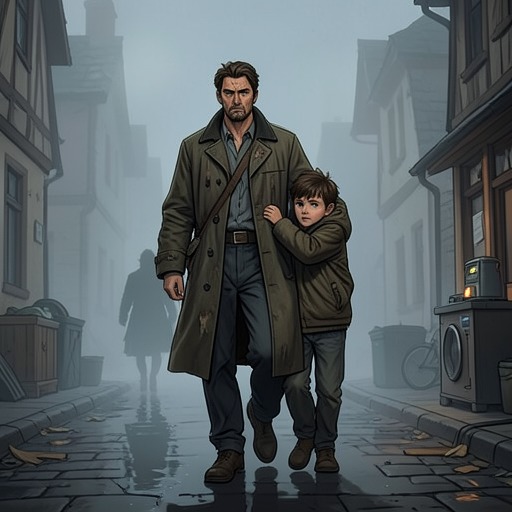
Straker opens the door almost immediately when Parkins Gillespie knocks, as though he has been waiting directly behind it. He greets Parkins with a narrow smile and a handshake whose gentle pressure is backed by an unexpectedly powerful, very dry hand. The encounter establishes Straker as controlled, polished, and physically unsettling without requiring the town to understand why. He offers coffee or sherry, declines to explain himself beyond ordinary business language, and maintains an attentive intensity that makes a routine inspection feel like an examination conducted by both sides.
Straker explains that Kurt Barlow is in New York on a buying trip and is not expected back until at least October 10. He identifies his partner by his full name and says that the two men have worked together in London and Hamburg. The shop, he claims, is their retirement: modest, tasteful, and intended to provide no more than a living while allowing them to pursue old and fine things and build a reputation throughout New England. This account gives the enterprise a respectable surface, but it also emphasizes the partnership’s long history and international reach. Barlow is absent at the moment of opening, yet his name already governs the premises.
When Parkins asks about the house, Straker says that it needs a great deal of work but that the partners have time. The statement is innocuous as a renovation remark, but within the larger pattern of the novel it becomes a chilling declaration of patience. Straker also denies seeing any children around the property when Parkins asks whether local boys have been harassing the newcomers. The exchange places the newly occupied house beside the town’s immediate anxiety: a child has been misplaced, and the men connected with the house claim to have seen no children at all.
The Pattern of Disappearance
The connection between the reoccupation and the disappearance of Ralphie Glick is made explicit through comparison with the house’s earlier history. The last time the Marsten House was occupied, four children disappeared over a ten-year period. After a thirty-six-year interval, it is occupied again, and Ralphie disappears almost immediately. The numerical pattern is too precise to remain a piece of background: the renewed presence in the house supplies the event with an ominous historical frame.
The comparison becomes more persuasive because the town’s earlier missing children were never found. A search through old issues of the Ledger records four disappearances between 1928 and 1939, during the years Hubert and Birdie lived in the house. Rural explanations were available—children could become lost, die of exposure, or be buried by a gravel-pit slide—but none of these explanations produced remains. The absence of bodies leaves the old cases suspended between ordinary misfortune and concealed violence, allowing the new disappearance to reactivate rather than merely resemble them.
A comparison with the period from 1939 to 1970 makes the recurrence sharper. Three children disappeared during those later decades, but each case acquired an explanation: one runaway was eventually found working in Boston, another child was recovered from the Androscoggin, and a third was found buried off Route 116 after an apparent hit-and-run. Against these resolved cases, the four earlier disappearances and Ralphie’s sudden vanishing form a distinct cluster. The evidence does not prove the house’s agency by ordinary investigative standards, but it makes coincidence increasingly difficult to accept.
The House as a Vessel of Buried Knowledge
The reoccupation also exposes the limits of the town’s collective memory. Jerusalem’s Lot remembers that Hubert Marsten killed his wife, but it does not know what preceded the shooting or that Birdie begged him to do it. Older residents recall charred papers found in the upstairs fireplace, yet they do not know that the papers represented twelve years of correspondence between Hubert and an Austrian nobleman named Breichen, begun through a peculiar Boston bookseller who later died violently. The house thus contains not a single secret but layers of incomplete recollection, in which rumor preserves the outline of horror while erasing its causes and connections.
This structure of partial knowledge extends beyond the Marsten history. The town knows many scandals only in distorted form, such as the belief that Albie Crane’s wife ran away with a traveling man when Albie had actually killed her and hidden her body in an old well. Local memory is therefore neither simple ignorance nor reliable communal testimony. It is a system of substitutions, omissions, and inherited fragments. When Straker and Barlow return the house to use, they do not bring an alien mystery into a blank community; they enter a place already trained to carry secrets without fully naming them.
Later archival material deepens the sense that Jerusalem’s Lot has been repeatedly shaped by concealed histories. Robert Boone’s coded diary reveals that the older town predated nearby Chapelwaite and Preacher’s Corners, having been founded in 1710 by a splinter Puritan group led by James Boon. Its church-centered community was marked by religious extremism, exorcism rites, incest, and degeneration, while the diary identifies a relationship between the Boone family, the town, and a forbidden book preserved in a desecrated church. The nineteenth-century papers connected with Charles Boone and Calvin McCann are themselves complicated by madness, forgery, and disputed testimony, but the uncertainty strengthens rather than dissolves the novel’s pattern: Jerusalem’s Lot repeatedly buries its origins beneath damaged documents and unreliable explanations.
Consequences and Narrative Significance
The immediate consequence of the reoccupation is that the Marsten House ceases to be a memorial ruin and becomes an operating center. Straker’s shop gives the partnership a public address and respectable commercial cover, while the house provides privacy, elevation, and access to the town’s vulnerable spaces. The polished display window invites inspection; the occupied house repels it. Together they create a division between what the town is permitted to see and what the newcomers are able to conceal.
The town’s ordinary confidence makes the transition more disturbing. Jerusalem’s Lot receives national wars and political crises largely through television and treats its own dangers as isolated exceptions. Its residents believe that nothing truly terrible can happen in such a pleasant little town. The reoccupation breaks that assumption without announcing the break directly. A business opens, a partner is said to be away, a house needs repairs, and a child disappears. The supernatural catastrophe enters through the language of routine administration.
The later outbreak confirms the reoccupation’s significance. As the vampire threat spreads, the town becomes a landscape of lit houses, locked interiors, cemeteries, roads, and rooms whose occupants sense danger without understanding it. Awake residents turn on every light, search drawers and attics for religious symbols, and refuse to look out their windows. The community’s familiar geography is thereby rewritten by fear: the house that once stood apart becomes part of a wider occupation, while ordinary homes become temporary defensive enclosures.
The Marsten House’s reoccupation is consequently both an event and a structural repetition. It links the present to the child disappearances of 1928–1939, connects commercial respectability with hidden predation, and turns inherited local legend into an active mechanism of terror. Its power lies in the way it makes recurrence visible before the town can interpret it. By the time Jerusalem’s Lot understands that the old history has returned, the house is no longer merely where something happened in the past; it is where the past has found a new form and begun acting again.